Why Do Coconut Shell Charcoal Briquettes Differ in Quality?
Introduction
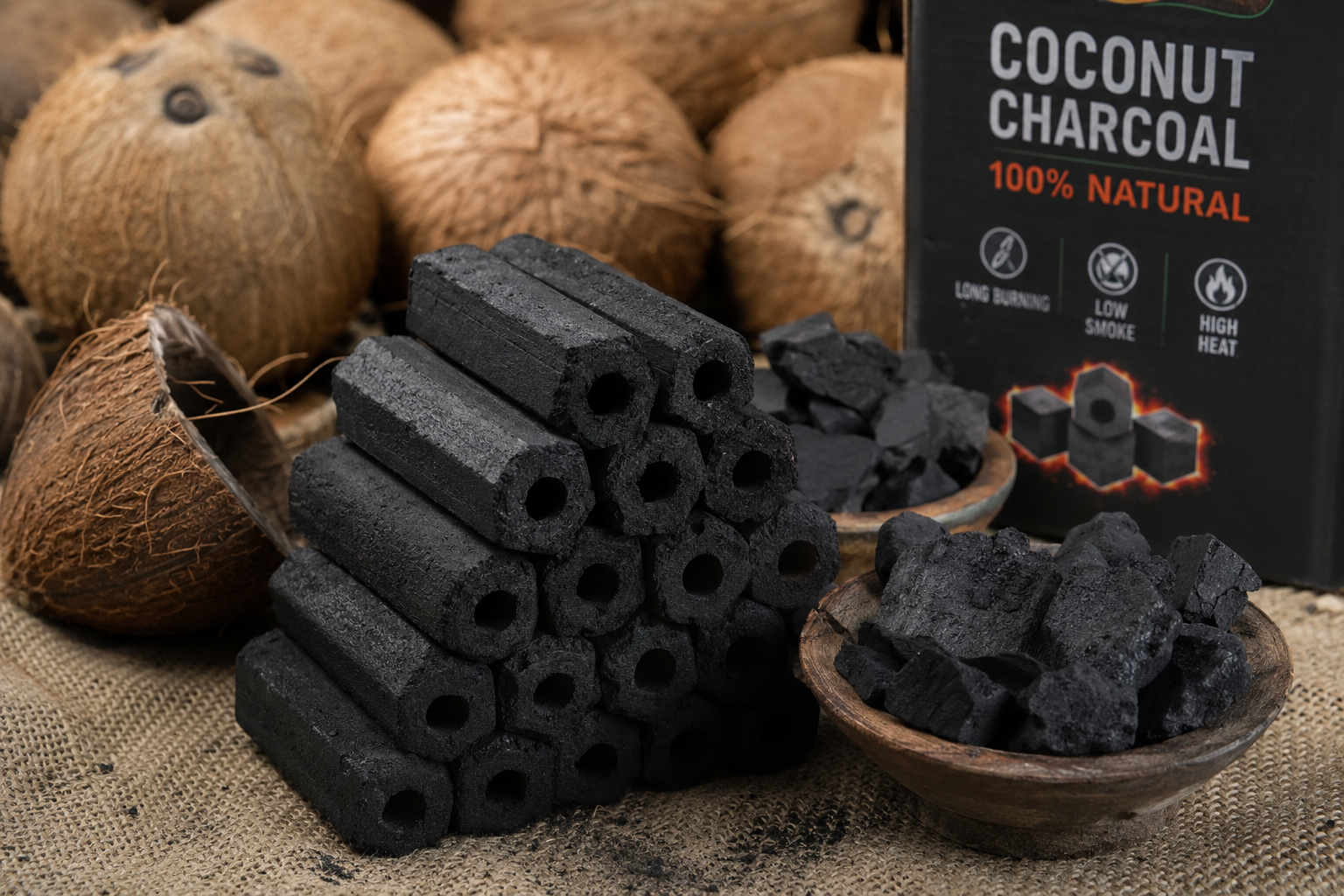
At first glance, many coconut shell charcoal briquettes look very similar. They may share the same shape, color, and even packaging style.
However, when used in restaurants, BBQ operations, hotels, or export markets, their actual performance can vary significantly.
Some briquettes produce higher heat, burn longer, generate less smoke, and leave less ash. Others may be difficult to ignite, burn inconsistently, or create unpleasant odors during use.
These differences are not caused by a single factor. The quality of coconut shell charcoal briquettes depends on multiple stages, from raw material selection to production methods and quality control standards.
Coconut Shell Quality
Raw material selection is the foundation of charcoal briquette quality.
Coconut shells from mature tall coconut trees, commonly found in Southern Thailand, are generally thicker and denser than shells from younger or smaller trees.
These thicker shells typically contain higher carbon content and can produce charcoal with stronger heat output and longer burning duration.
In contrast, thinner or lower-density shells may result in charcoal that burns faster and provides less consistent performance.
For manufacturers, selecting the right raw material source is one of the most important factors in producing high-quality charcoal briquettes.
Carbonization Process
After raw material selection, the carbonization process plays a critical role in determining charcoal quality.
Proper carbonization under controlled temperatures helps produce charcoal with higher fixed carbon content, lower moisture levels, and fewer volatile compounds.
The result is cleaner combustion, stronger heat output, and lower smoke generation.
Poorly controlled carbonization may leave partially carbonized material inside the charcoal, leading to smoke, odor, and inconsistent burning performance.
Charcoal Selection Before Production
Not all charcoal produced during carbonization has the same quality.
Premium manufacturers often sort and select charcoal before processing, choosing material with higher carbon content and more consistent performance.
Some producers may mix different charcoal grades together to reduce production costs.
This directly affects heat consistency, burn duration, and overall product quality.
Binder Quality
Most coconut shell charcoal briquettes require a natural binder during production.
The type and proportion of binder influence product strength, durability, and ash production.
A well-balanced formula helps maintain briquette integrity while preserving heating performance.
Excessive binder usage may increase ash content and reduce overall efficiency.
Briquetting Process
Many buyers focus on raw materials, but the briquetting process itself is equally important.
A high-quality briquetting process creates uniform density throughout the product.
This helps ensure stable heat output, longer burning duration, and greater durability during transportation and handling.
Poor briquetting can lead to uneven density, causing inconsistent burning characteristics and reduced performance.
Drying Process
Drying is one of the most overlooked stages in charcoal briquette manufacturing.
After briquetting, the product must be properly dried to reduce internal moisture levels.
If excessive moisture remains inside the briquette, it may become difficult to ignite, produce lower heat output, and generate smoke or odor during the initial stage of combustion.
Manufacturers with efficient drying systems can achieve more consistent moisture levels throughout the product.
Properly dried briquettes ignite more easily, burn hotter, last longer, and create a cleaner grilling experience.
For restaurants, hotels, distributors, and export customers, drying quality can have a significant impact on overall product performance.
The KINGBE Production Approach
As a manufacturer serving restaurants, hospitality businesses, and export markets, KINGBE believes that charcoal quality depends on much more than raw materials alone.
Every stage of production contributes to the final performance of the product.
From coconut shell selection and carbonization to briquetting, drying, and quality control, consistency is a key priority throughout the manufacturing process.
Particular attention is given to briquette density and moisture control, as these factors directly affect ignition, heat output, burn duration, and odor during use.
This commitment to consistency has helped KINGBE supply charcoal solutions for Korean BBQ restaurants, Yakiniku restaurants, seafood restaurants, hotels, and international export customers.
Quality Control Standards
Reliable manufacturers maintain quality control throughout the production process.
Common quality indicators include moisture content, fixed carbon content, ash content, product durability, density, and burning performance.
Consistent quality control helps ensure that every production batch performs reliably and meets customer expectations.
For restaurant operators, distributors, and importers, product consistency is often just as important as product performance.
Conclusion
Although many coconut shell charcoal briquettes appear similar on the surface, their actual performance can vary greatly.
Raw material quality, carbonization methods, charcoal selection, binder formulation, briquetting quality, drying efficiency, and quality control standards all contribute to the final product.
For restaurants, hotels, distributors, and importers, choosing a manufacturer with consistent production standards is often more important than simply choosing the lowest price.
In many cases, better production methods result in stronger heat, longer burn duration, easier ignition, lower odor, and a more consistent grilling experience.
At KINGBE, we believe that consistent quality begins long before the charcoal reaches the customer. It starts with careful material selection, controlled production processes, and a commitment to continuous quality improvement throughout every stage of manufacturing.